|
|
Buckingham Palace is The Queen's official London residence. Until the 18th century, Buckingham House, which occupied part of the modern site, was the London home of the Dukes of Buckingham. In 1762 King George III bought Buckingham House and moved there with his young consort Queen Charlotte.
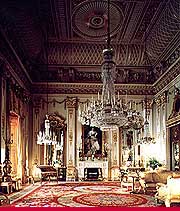
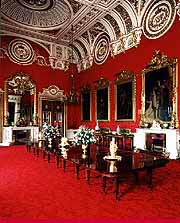
King George IV who acceded to the Throne in 1820 commissioned his architect John Nash to build a State Palace. Nash added to the existing building rather than rebuild entirely, and much of the structure and decoration of Buckingham Palace as we see it today are due to Nash and his Royal patron. He added wings at the front and increased the depth at the back, creating along the first floor of his new Garden Front an unrivalled suite of rooms. However, on George IV's death Nash was dismissed and the Palace was not completed until Queen Victoria's reign. George IV never lived in Buckingham Palace, nor did his younger brother William IV. Queen Victoria was the first sovereign to live in Buckingham Palace. The 19-year-old Queen took up residence, just three weeks after her accession on 13 July 1837. Nash's Palace soon became too small for a growing family and it was Edward Blore who constructed the East front, joining the wings of Nash's Palace and thereby creating the quadrangle and a forecourt. The Marble Arch was moved to its present site at the northern end of Hyde Park at the same time. The facade of the Palace as we know it today was re-faced in Portland stone to a new design by Aston Webb in 1913. The Queen's Gallery is on the site of one of Nash's conservatories, changed by Blore into a Chapel for Queen Victoria but destroyed in an air raid in September 1940. It was opened in 1962 after an initiative by The Duke of Edinburgh to convert the bomb damaged area into a small gallery to show works of art from the Royal Collection. The Royal Mews is one of the finest and oldest working stables in existence, housing the Monarch's magnificent State carriages, including the Gold State Coach or Coronation Coach built in 1762, together with their horses and State liveries. The State Rooms, Royal Mews and Queen's Gallery are open to vistors. |
|||||
    |
||||||
 |
 |
 |
 |
|
||