|
|
Background
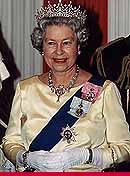
Education Early public life Marriage and family Accession and coronation Work as monarch Anniversaries Horsemanship BackgroundThe Queen was born in London on 21 April 1926, the first child of The Duke and Duchess of York, subsequently King George VI and Queen Elizabeth. Five weeks later she was christened Elizabeth Alexandra Mary in the chapel at Buckingham Palace. The Princess's early years were spent at 145 Piccadilly, the London house taken by her parents shortly after her birth; at White Lodge in Richmond Park; and at the country homes of her grandparents, King George V and Queen Mary, and the Earl and Countess of Strathmore. When she was six years old, her parents took over Royal Lodge in Windsor Great Park as their own country home. EducationPrincess Elizabeth was educated at home with Princess Margaret, her younger sister. After her father succeeded to the throne in 1936 and she became heir presumptive, she started to study constitutional history and law. She also studied art and music; learned to ride (she has been a keen horsewoman since early childhood); and enjoyed amateur theatricals and swimming - she won the Children's Challenge Shield at London's Bath Club when she was thirteen. She enrolled as a Girl Guide when she was eleven, and later became a Sea Ranger. Early public lifeAs the Princess grew older she began to take part in public life. She broadcast for the first time in October 1940, when she was fourteen; she sent a message during the BBC's children's programme to all the children of Britain and the Commonwealth. In early 1942 she was appointed Colonel of the Grenadier Guards, and on her sixteenth birthday carried out her first public engagement, when she inspected the regiment. Thereafter her official duties increased, particularly in connection with young people: she became President of the Queen Elizabeth Hospital for Children in Hackney and the National Society for the Prevention of Cruelty to Children. At about this time she also began to accompany the King and Queen on many of their tours within Britain. Shortly after her eighteenth birthday, Princess Elizabeth was appointed a Counsellor of State during the King's absence on a tour of the Italian battlefields and, for the first time, carried out some of the duties of Head of State. In early 1945 the Princess was made a Subaltern in the Auxiliary Territorial Service (ATS); by the end of the war she had reached the rank of Junior Commander. When the Women's Royal Army Corps was founded in 1949, she became an Honorary Senior Controller and later Honorary Brigadier - an appointment she resigned on becoming Queen. After the end of the war Princess Elizabeth's public engagements continued to grow, and she travelled extensively to attend public functions throughout the British Isles. Her first official overseas visit took place in 1947, when she accompanied her parents and sister on a tour of South Africa. During this tour she celebrated her twenty-first birthday, and gave a broadcast address dedicating herself to the service of the Commonwealth - a dedication she repeated five years later on her accession to the throne. Marriage and familyShortly after the Royal family returned from South Africa, the Princess's engagement to Lieutenant Philip Mountbatten was announced. The couple, who had known each other for many years, were married in Westminster Abbey on 20 November 1947. Lieutenant Mountbatten, now His Royal Highness The Prince Philip, Duke of Edinburgh, was the son of Prince Andrew of Greece and a great-great-grandson of Queen Victoria. The Royal couple had four children, and so far have six grandchildren. Prince Charles, now The Prince of Wales, Heir apparent to the throne, was born in 1948, and his sister, Princess Anne, now The Princess Royal, two years later. Their third child, Prince Andrew, arrived in 1960 and the fourth, Prince Edward, in 1964. They will celebrate their golden wedding in November 1997. Their grandchildren are Peter and Zara Phillips (b. 1977 and 1981); Prince William of Wales and Prince Henry of Wales (b. 1982 and 1984); and Princess Beatrice of York and Princess Eugenie of York (b. 1988 and 1990). Accession and coronationAfter her marriage Princess Elizabeth paid formal visits with The Duke of Edinburgh to France and Greece; in autumn 1951 they toured Canada. She also visited Malta four times while The Duke was stationed there on naval duties. In 1952, King George VI's illness forced him to abandon his proposed visit to Australia and New Zealand; The Princess, accompanied by Prince Philip, took his place. On 6 February, during the first stage of this journey, in Kenya, she received the news of her father's death and her own accession to the throne. Her Majesty's coronation took place in Westminster Abbey on 2 June 1953. Representatives of the peers, the Commons and all the great public interests in Britain, the Prime Ministers and leading citizens of the other Commonwealth countries, and representatives of foreign states were present. The ceremony was broadcast on radio around the world, but it was television, then in relative infancy, that brought home the splendour and the deep significance of the coronation to many hundreds of thousands of people in a way never before possible. The Coronation was followed by drives through every part of London, by a review of the fleet at Spithead, and by visits to Scotland, Northern Ireland and Wales. Work as monarchIn autumn 1954 Her Majesty set out to accomplish, as Queen, the Commonwealth tour she had begun before the death of her father. With The Duke of Edinburgh she visited Bermuda, Jamaica, Fiji, Tonga, New Zealand, Australia, Ceylon, Uganda, Malta and Gibraltar. This was the first of innumerable tours of the Commonwealth they have undertaken at the invitation of the host Governments. During the past forty years The Queen and Prince Philip have also made frequent visits to other countries outside the Commonwealth at the invitation of foreign Heads of State. Since her coronation, The Queen has also visited nearly every county in Britain, seeing new developments and achievements in industry, agriculture, education, the arts, medicine and sport and many other aspects of national life. As Head of State, The Queen maintains close contact with the Prime Minister, with whom she has a weekly audience when she is in London, and with other Ministers of the Crown. She sees all Cabinet papers and the records of Cabinet and Cabinet Committee meetings. She receives important Foreign Office telegrams and a daily summary of events in Parliament. Her Majesty acts as host to the Heads of State of Commonwealth and other countries when they visit Britain, and receives other notable visitors from overseas. She holds Investitures in Britain and during her visits to other Commonwealth countries, at which she presents honours to people who have distinguished themselves in public life. As Sovereign, Her Majesty is head of the Navy, Army and Air Force of Britain. On becoming Queen she succeeded her father as Colonel-in-Chief of all the Guards Regiments and the Corps of Royal Engineers and as Captain-General of the Royal Regiment of Artillery and the Honourable Artillery Company. At her Coronation she assumed similar positions with a number of other units in Britain and elsewhere in the Commonwealth. (A full list appears in Whitaker's Almanack.) Every year, Her Majesty entertains some 48,000 people from all sections of the community (including visitors from overseas) at Royal Garden Parties and other occasions. At least three garden parties take place at Buckingham Palace and a fourth at Holyroodhouse, in Edinburgh. Additional 'special' parties are occasionally arranged, for example to mark a significant anniversary for a charity. In 1997, there will be a special Garden Party attended by those sharing The Queen and The Duke of Edinburgh's golden wedding anniversary. Her Majesty also gives regular receptions and lunches for people who have made a contribution in different areas of national and international life. She also appears on many public occasions such as the services of the Orders of the Garter and the Thistle; Trooping the Colour; the Remembrance Day ceremony; and national services at St Paul's Cathedral and Westminster Abbey. The Queen is Patron or President of over 700 organisations. Each year, she undertakes a large number of engagements: some 585 in 1996. AnniversariesIn 1977 The Queen's Silver Jubilee was celebrated in Britain and throughout the Commonwealth. Accompanied by The Duke of Edinburgh, The Queen travelled some 90,000 kilometres (56,000 miles) to share the anniversary with her people. Enormous crowds greeted them wherever they went, and millions more shared in the celebrations through radio and television. In 1986 The Queen took part in celebrations in Windsor and London to mark her sixtieth birthday. Although it was not regarded as a Jubilee, the 40th anniversary of The Queen's Accession in 1992 was marked by a number of events and community projects in the UK. These were organised privately or through the Royal Anniversary Trust. On Accession Day itself, 6 February, the BBC broadcast Elizabeth R, a television documentary on The Queen's working life. This was subsequently shown in over 25 countries around the world. HorsemanshipHer Majesty takes a keen and highly knowledgeable interest in horses. She attends the Derby at Epsom, one of the classic flat races in Britain, and the Summer Race Meeting at Ascot, which has been a Royal occasion since 1911. As an owner and breeder of thoroughbreds, she often visits other race meetings to watch her horses run, and also frequently attends equestrian events. In 1984, 1986 and 1991 Her Majesty made brief private visits to the United States to see stallion stations and stud farms in Kentucky. |
||||||
    |
|||||||
 |
 |
 |
 |
|
|||