|
The TudorsHenry VIIAlthough supported by Lancastrians and Yorkists alienated by Richard III's usurpation, Henry VII's first task was to secure his position. In 1486 he married Elizabeth of York, eldest daughter of Edward IV, thus uniting the Houses of York and Lancaster. Henry's reign (1485-1509) was troubled by revolts, sometimes involving pretenders (such as Perkin Warbeck and Lambert Simnel) who impersonated Edward V or his brother. In 1485, Henry formed a personal bodyguard from his followers known as the 'Yeomen of the Guard' (the oldest military corps in existence today).Henry strengthened the power of the monarchy by using traditional methods of government to tighten royal administration and increase revenues (reportedly including a daily examination of accounts). Royal income rose from an annual average of £52,000 to £142,000 by the end of Henry's reign. Little cooperation between king and parliament was required; during Henry's reign of 24 years, seven parliaments sat for some ten and a half months. Henry used dynastic royal marriages to establish his dynasty in England, and help maintain peace. One daughter, Margaret, was married to James IV of Scotland (from whom Mary, Queen of Scots and her son, James VI of Scotland and James I of England, were descended); the other daughter married Louis XII of France. Henry spent money shrewdly and left a full treasury on his death in 1509. |
|||||||
|
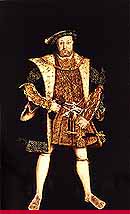
Henry VIIIHenry VIII (reigned 1509-47) was 17 when he became king. His first wife, Catherine of Aragon, provided him with a daughter, Mary, but no male heir. In order to divorce her, he broke with the Roman Catholic Church and declared himself Supreme Head of the Church of England. Five subsequent marriages produced two children, Elizabeth and Edward.The break with Rome led to the Dissolution of the Monasteries (in which monastic lands and buildings were sold or disposed of, and the monks disbanded or imprisoned) and the beginnings of the English Reformation. Henry's involvement in European politics brought him into conflict with the Scots who were defeated at Solway Moss in 1542 (the Scots had been defeated before at the battle of Flodden in 1516). Control of Wales was strengthened by the Acts of Union of 1536 and 1542 which united England and Wales administratively and legally, and gave Wales representation in Parliament. Henry died in 1547 leaving his sickly, 10-year-old son to inherit the throne as Edward VI (reigned 1547-53). Edward VI, Jane GreyOn Henry's death, Edward Seymour, Duke of Somerset, the new King's uncle, became Protector. During Edward's reign, the Church of England became more explicitly Protestant. An English Prayer Book was introduced in 1549 and signs of Roman Catholic practices, including statues and stained glass, were eradicated.In 1550 the Duke of Northumberland overthrew, and subsequently executed, Edward Seymour. The young king was ailing and Northumberland hurriedly married his son to Lady Jane Grey, one of Henry VIII's nieces and a claimant to the throne. Edward accepted Jane as his heir and on his death from tuberculosis in 1553 Jane assumed the throne. The country, however, rallied to Mary, Catherine of Aragon's daughter and a devout Roman Catholic, and Jane reigned for only nine days. She was executed in 1554 (as was her husband). Mary IMary I (reigned 1553-58) restored papal supremacy in England, and reintroduced Catholic bishops and monastic orders. In 1554, Mary married Philip, King of Spain; the marriage was childless, and Philip spent most of the marriage on the continent. Mary, against Philip's advice, began an ill-judged campaign of persecution to secure the religious conversion of the country, including burning Protestants for heresy. Her marriage to Philip drew England into a war with France. Popular discontent grew when Calais, the last of England's continental possessions, was captured by the French in 1558. Mary died later that year, leaving the crown to her sister Elizabeth. |
||||||
|
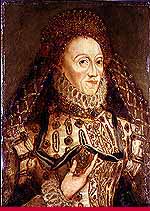
Elizabeth IElizabeth I (reigned 1558-1603), daughter of Henry VIII and Anne Boleyn, returned England to Protestantism while still managing to secure order. She refused to marry or name her successor as marriage could have created foreign alliance difficulties or encouraged factionalism at home. Her rightful heir was her cousin, Mary, Queen of Scots, who, threatened by rebellion in Scotland, fled to England. Imprisoned by Elizabeth in 1567, Mary plotted with English Roman Catholics and with Spain, France and the Pope. The threat to the English throne which this posed resulted in Mary's execution in 1587 and led to outright war with Spain. In 1588 Philip of Spain's invasion fleet, the 'Armada', was defeated. There were two further Armadas in the 1590s, and an Irish revolt in 1595 assisted by Spain which was eventually put down in 1601.The financial strains caused by the war against Spain (made worse by poor harvests) and the need for additional money made the summoning of Parliament more necessary. Elizabeth did not try to put the Crown on a permanently solvent basis. In addition to sharp debates over revenue raising measures such as monopolies, Parliament continued its pressure on the queen to deal with the question of the succession. However, Elizabeth died in 1603 still refusing to name her successor. |
||||||
    |
|||||||
 |
 |
 |
 |
|
|||