|
|
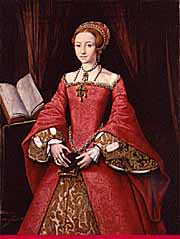
Elizabeth IElizabeth I - the last Tudor monarch - was born at Greenwich on 7 September 1533, the daughter of Henry VIII and his second wife, Anne Boleyn. Her early life was full of uncertainties, and her chances of succeeding to the throne seemed very slight once her half-brother Edward was born in 1537. She was third in line behind her Roman Catholic half-sister, Princess Mary. Roman Catholics, indeed, always considered her illegitimate and she only narrowly escaped execution in the wake of a failed rebellion against Queen Mary and her Roman Catholic husband, Philip II of Spain, in 1554.Elizabeth succeeded to the throne on her half-sister's death from cancer in November 1558. She was very well educated (fluent in six languages), and had inherited intelligence, determination and shrewdness from both parents. Her 45 year reign is generally considered one of the most glorious in English history. During it a secure Church of England was established. Its doctrines were laid down in the 39 Articles of 1563, a compromise between Roman Catholicism and Protestantism. Most of her subjects accepted it as the basis of their faith, and her church settlement probably saved England from religious wars like those which France suffered in the second half of the 16th century. Elizabeth's reign also saw many brave voyages of discovery, including those of Sir Francis Drake and Sir Walter Raleigh particularly in the Americas. These expeditions prepared England for an age of colonisation which began a few years after she died. In 1588, aided by bad weather, the English navy scored a great victory over the Spanish invasion fleet - the 'Armada'. The Armada was intended to overthrow the Queen and re-establish Roman Catholicism in England by conquest, as Philip II believed he had a claim to the English throne. The arts flourished during Elizabeth's reign; miniature painting reached its high point, and Elizabeth was a patron of both Jonson and Shakespeare, attending the first performance of 'A Midsummer Night's Dream'. The image of Elizabeth's reign is one of triumph and success. The Queen herself was often called 'Gloriana', 'Good Queen Bess' and 'The Virgin Queen'. Investing in expensive clothes and jewellery (to look the part, like all contemporary sovereigns), she cultivated this image by touring the country in regional visits known as 'progresses' often riding on horseback rather than by carriage. Elizabeth chose never to marry. If she had chosen a foreign prince, he would have drawn England into foreign policies for his own advantages (as in her sister Mary's marriage to Philip of Spain); marrying a fellow countryman could have drawn the Queen into factional infighting. Elizabeth used her marriage prospects as a political tool in foreign and domestic politics. However, the 'Virgin Queen' was presented as a selfless woman who sacrificed personal happiness for the good of the nation, to which she was, in essence, 'married'. Late in her reign, she addressed Parliament in the so-called 'Golden Speech' of 1601 when she told MPs: "There is no jewel, be it of never so rich a price, which I set before this jewel; I mean your love." She seems to have been very popular with the vast majority of her subjects. However, Elizabeth's reign was one of considerable danger and difficulty for many, with threats of invasion from Spain through Ireland, and from France through Scotland. Much of northern England was in rebellion in 1569-70; Elizabeth passed harsh laws against Roman Catholics after plots against her life were discovered. One such plot resulted in the execution of Mary Queen of Scots, a claimant and possible successor to Elizabeth. The nation also suffered from high prices and severe economic depression, especially in the countryside, during the 1590s. The war against Spain was not very successful after the Armada had been beaten and, together with other campaigns, it was very costly. Though she kept a tight rein on government expenditure, Elizabeth left large debts to her successor. Overall, Elizabeth's always shrewd and, when necessary, decisive leadership brought successes during a period of great danger both at home and abroad. She died at Richmond Palace on 24 March 1603, having become a legend in her lifetime. The date of her accession was a national holiday for 200 years. |
||||
    |
|||||
 |
 |
 |
 |
|
|