|
|
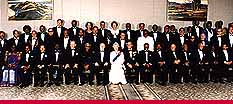
The CommonwealthThe Commonwealth is a voluntary association of 53 independent countries, almost all of which were formerly under British rule. While remaining entirely responsible for their own policies, member countries choose to consult and co-operate in certain areas such as strengthening democracy by good government, promoting human rights and working for social and economic development of poorer countries. Much of the strength of the Commonwealth is derived from its non-governmental and informal links, such as teacher training schemes, youth ministries, distance education, science and environmental projects, shared sports and arts festivals. This means that it is as much a commonwealth of peoples as of governments.The 1.6 billion people of Commonwealth countries make up over a quarter of the world's population, and over 50 per cent of the population of the Commonwealth is under 25. The great majority of Commonwealth members are parliamentary democracies. Trade is one of the many links between Britain and the Commonwealth. In 1995, visible UK exports to Commonwealth countries amounted to £17,248 billion or 10.26 per cent of total British exports. Membership of the Commonwealth has, since its beginning, been open to any independent state which was once ruled or administered by Britain or other Commonwealth countries, and recognises The Queen as Head of the Commonwealth. (In 1995, Mozambique became the first country to join which had not previously had such links with Britain.) Almost all countries, when they became independent of the United Kingdom, have chosen to join the Commonwealth but, since the link is entirely voluntary, any member can withdraw at any time, for example, the Republic of Ireland did so in 1949, South Africa in 1961 (subsequently rejoined in 1994) and Fiji in 1987. |
||||
    |
|||||
 |
 |
 |
 |
|
|