|
|
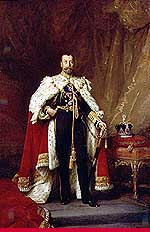
The WindsorsGeorge VGeorge V's reign (1910-36) began amid the continuing constitutional crisis over the House of Lords, which refused to pass a Parliament Bill limiting its powers (which would remove its power to veto a Bill from the Commons). After the Liberal government obtained the king's promise to create sufficient peers to overcome Conservative opposition in the Lords (and won a second election in 1910), the Parliament Bill was passed by the Lords in 1911 without a mass creation of peers.George visited India in 1911, the only King-Emperor to do so. In 1914 the First World War broke out; the King made over 450 visits to troops and over 300 visits to hospitals visiting wounded servicemen, he pressed for proper treatment of German prisoners-of-war and he pressed also for more humane treatment of conscientious objectors. In 1917 anti-German feeling led him to adopt the family name of Windsor (after the Castle of the same name). Support for home rule for Ireland had grown in the late 19th century. This was resisted by the Unionists in the north and by the Conservative Party. The 1916 Easter Rising in Dublin, and subsequent civil war resulted in the setting up of the Irish Free State (later to become the Irish Republic) in 1922, while the six northern counties remained part of the United Kingdom. George played a conciliatory role on this, and on other occasions, such as the General Strike of 1926. George readily accepted the first Labour government in 1924. Following the world slump of 1929, the king persuaded the Labour leader to head a National Government composed of all parties, which won the election of 1931. The Statute of Westminster of 1931 meant Dominion Parliaments could now pass laws without reference to United Kingdom laws, and abolished various reserve powers still possessed by the Crown and Parliament. This paradoxically increased the monarchy's importance, since the Dominions (no longer subordinated to one supreme Parliament at Westminster) were now linked through common allegiance to the crown. George started the annual Christmas Broadcast by the sovereign to the Empire (more recently to the Commonwealth), the first being transmitted in 1932. In 1935, the king celebrated his Silver Jubilee. He died in 1936. Edward VIIIThe king's son Edward succeeded to the throne as Edward VIII (reigned January-December 1936). As Prince of Wales he had successfully carried out a number of regional visits (including areas hit by economic depression) and other official engagements. These visits and his official tours overseas, together with his good war record and genuine care for the underprivileged, had made him popular.The first monarch to be a qualified pilot, Edward created The King's Flight (now known as 32 (the Royal) Squadron) in 1936 to provide air transport for the Royal Family's official duties. In 1930, the Prince, who had already had a number of affairs, had met and fallen in love with a married American lady, Mrs Wallis Simpson. Concern about Edward's private life grew in the Cabinet, opposition parties and the Dominions, when Mrs Simpson obtained a divorce in 1936 and it was clear that Edward was determined to marry her. Eventually Edward realised he had to choose between the Crown and Mrs Simpson who, as a twice-divorced woman, would not have been acceptable as queen. On 10 December 1936, Edward VIII executed an Instrument of Abdication which was given legal effect the following day, when Edward gave Royal Assent to His Majesty's Declaration of Abdication Act, by which Edward VIII and any children he might have were excluded from succession to the throne. In 1937, Edward was created Duke of Windsor and married Wallis Simpson. During the Second World War, the Duke of Windsor escaped from Paris, where he was living at the time of the fall of France, to Lisbon in 1940. The Duke of Windsor was then appointed Governor of the Bahamas, a position which he held until 1945. He lived abroad until the end of his life, dying in 1972 in Paris (he is buried at Windsor). Edward was never crowned; his reign lasted 325 days. His brother Albert became king, using his last name George. |
||||||
|
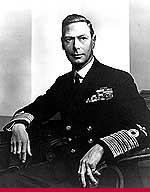
George VIGeorge VI (reigned 1936-52), a conscientious and dedicated man, worked hard to adapt to the role into which he was suddenly thrown. In 1923 he had married Lady Elizabeth Bowes-Lyon; and he carried out many official engagements at home and abroad, and established The Duke of York's Summer Camps for boys from all backgrounds. He did not expect to become king.The king paid a State Visit to France in 1938, and to Canada and the United States in 1939 (he was the first British monarch to enter the United States). His dedication to duty, particularly during the Second World War, when he remained for most of the time at Buckingham Palace (the Palace was bombed nine times during the war), and when he and his wife visited severely bombed areas in the East End of London and elsewhere in the country, gained him great popularity. Recognising the total nature of modern warfare, in 1940 the king instituted the George Cross and George Medal, to be awarded for acts of bravery by citizens. On VE (Victory in Europe) Day 1945, Buckingham Palace was a focal point of the celebrations. The war had immeasurably strengthened the link between the king and his people. In 1947, the King undertook a major tour of South Africa, accompanied by the Queen and their daughters, Princess Elizabeth and Princess Margaret - the first time a sovereign had undertaken a tour with his family. When India and Pakistan became independent in 1947, George ceased to be Emperor of India. Changes in the Commonwealth meant that its tie was no longer based on common allegiance to the Crown, but upon recognition of the sovereign as Head of the Commonwealth. These changes in the Commonwealth relationship and the social reforms of the post-war Labour government occurred against the background of Britain's weak post-war economic position and the beginning of the Cold War. The strain of the Second World War and the tensions of the post-war period had taken their toll on the king's health. In 1952 he died at Sandringham. |
||||||
    |
|||||||
 |
 |
 |
 |
|
|||