|
The PlantagenetsHenry IIIHenry III (reigned 1216-1272), John's son, was only nine when he became king. By 1227, when he assumed power from his regent, order had been restored based on his acceptance of Magna Carta. However, the king's failed campaigns in France, his choice of foreigners as friends and advisers, together with the cost of his scheme to make one of his younger sons king of Sicily and help the Pope against the Holy Roman Emperor, led to further disputes with the barons and united opposition in Church and State. The Provisions of Oxford (1258) and the Provisions of Westminster (1259) were attempts by the nobles to curb the king's power, control appointments and set up an aristocratic council.Henry renounced the Provisions in 1264 and war broke out. The barons under their leader, Simon de Montfort, were initially successful, but Henry and his son, Edward, finally defeated and killed de Montfort at the Battle of Evesham in 1265. Royal authority was restored by the Statute of Marlborough (1267), in which the king also promised to uphold Magna Carta and some of the Provisions of Westminster. |
|||||||
|
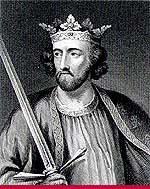
Edward IEdward I (1272-1307), who succeeded his father, was an able administrator and law maker. He re-established royal power, investigating many of the abuses resulting from weak royal government and issuing new laws. Edward was an effective soldier, gaining experience from going on crusade to Egypt and Syria before he became king. In 1276 Edward invaded Wales where Llewelyn ap Gruffydd, Prince of Wales, had built up considerable power. In a series of campaigns Edward gained control of Wales, building strong castles to secure his conquests. Llewelyn was killed and in 1284, the Statute of Wales brought Wales under Edward's rule. In 1301, he created his eldest son, Edward, the first English Prince of Wales.Wanting to unite the country behind him and to raise money for all these campaigns, in 1295 the king called what became known as the 'Model Parliament'. To this he summoned not only the aristocracy and the prelates, but also the knights of the shires, burgesses from the towns and junior clergy, thus creating a Parliament in approximately its modern form. From this date onwards, this system of representation became the norm. In 1296 Edward invaded Scotland, successfully seizing the king of Scots and the Stone of Scone. However, a guerrilla war broke out and William Wallace, the Scottish leader, defeated the English at Stirling Bridge. Wallace was finally captured and executed in 1305. Edward died in 1307, when he was about to start another campaign against the Scots. In 1314 Robert the Bruce, who had become king of Scots in 1306, defeated the English at the Battle of Bannockburn. Edward IIEdward II (reigned 1307-27) had few of the qualities which made a successful medieval king. He surrounded himself with favourites, and the barons, feeling excluded from power, rebelled. Throughout his reign different baronial groups struggled to gain power and control the King. The nobles' Ordinances of 1311, which attempted to limit royal control of finance and appointments, were ignored by Edward. Large debts (many inherited) and the Scots' victory at Bannockburn made Edward more unpopular. Finally, in 1326, Edward's wife, Isabelle of France, led an invasion against her husband. In 1327 Edward was made to renounce the throne in favour of his son, Edward, and was later murdered at Berkeley Castle. |
||||||
|
Edward IIIEdward III (reigned 1327-77) was 14 when he was crowned king and assumed government in his own right in 1330. An able soldier, and an inspiring leader, Edward founded the Order of the Garter in 1348. At the beginning of the Hundred Years War, the king invaded France in 1338. At first, Edward was unsuccessful, but in 1346 he landed in Normandy defeating the French king, Philip IV, at the Battle of Crecy and again at Poitiers (1356). By 1360 Edward controlled over a quarter of France. His successes consolidated the support of the nobles, lessened criticism of the taxes, and improved relations with Parliament. However, by 1374 the French king, Charles V, had reversed most of the English conquests. Failure abroad provoked criticism at home. In 1376, the 'Good Parliament' (which saw the election of the first Speaker to represent the Commons) attacked the high taxes and criticised the king's advisers. The ageing king withdrew to Windsor for the rest of his reign.Richard IIEdward's son, the Black Prince, died in 1376 and the King's grandson, Richard II (reigned 1377-99), inherited the throne on Edward's death. In 1381 the Peasants' Revolt broke out and Richard, aged 14, bravely rode to meet the rebels at Smithfield. Wat Tyler, one of the peasants' leaders, was killed and the revolt crushed. It was Richard who ordered the transformation of the Norman Westminster Hall (built in 1099 by William II, the Hall was the ceremonial and administrative centre of the kingdom; it also housed the Courts of Justice until 1882) to what it is today. Increasingly, Richard's dependence on a group of favourites provoked resentment. In 1388 the 'Merciless Parliament' sentenced many of the King's favourites to death. Richard took his revenge in 1397, arresting or banishing many of his opponents, including his cousin, Henry of Bolingbroke. The king's subsequent arbitrary behaviour alienated people further.Whilst Richard was in Ireland in 1399, Henry of Bolingbroke returned to claim his inheritance on the death of his father, John of Gaunt, Duke of Lancaster (a younger son of Edward III). Supported by some of the leading baronial families, Henry captured and deposed Richard. Bolingbroke was crowned king as Henry IV. Risings in support of Richard led to his murder in Pontefract Castle. |
||||||
    |
|||||||
 |
 |
 |
 |
|
|||