|
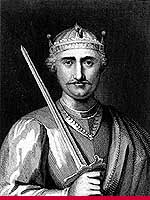
William I by George Vertue (1648-1756)
© Royal Collection |
 |
 |
|
|
The Normans
William I
The victory of William I, 'the Conqueror' (reigned 1066-1087) at Hastings and his subsequent coronation in Westminster Abbey on Christmas Day 1066 did not give him complete control of England. Remaining resistance was, however, severely crushed and castles were built to control the country (including a fortress on the site of Windsor Castle, and the White Tower at the Tower of London). The lands of defeated Saxon nobles were given to William's followers in return for military service by a certain number of knights, so that the tenants' foremost obligation was allegiance to the king. This firmly established the feudal system. In 1086, William commissioned the Domesday Book, to record land holdings for the assessment of taxes and other dues. William spent long periods in Normandy to maintain his authority there, dealing with rebellions and French invasions. William died in 1087 leaving Normandy to his eldest son, Robert, and England to his second son, William II Rufus (reigned 1087-1100).
William II
William extended his father's policies, taking royal power to the far north of England and helping to make Westminster the administrative centre of the kingdom.
Henry I
After William's death while hunting in the New Forest in 1100, his younger brother, Henry I (reigned 1100-35), succeeded to the throne. By 1106 he had captured Normandy from his brother, Robert, who then spent the last 28 years of his life as his brother's prisoner. An energetic and decisive ruler, Henry centralised the administration of England and Normandy in the royal court, and extended royal powers of patronage.
Stephen
Henry I was succeeded by his nephew, Stephen of Blois (reigned 1135-54), his only legitimate son having drowned in the wreck of the White Ship which sank in the English Channel in 1120. Although widely preferred in England and Normandy as Henry's successor, Stephen lacked ruthlessness and failed to inspire loyalty. Henry's daughter, Matilda, invaded England in 1139 to claim the throne and the country was plunged into civil war. Neither side was strong enough to win and the war ended only in 1153 when Matilda's son, Henry, Count of Anjou, was recognised as heir to the throne. |
|







