|
|
|
The Lancastrians
Henry IV
Henry IV (reigned 1399-1413) spent much of the early part of his reign fighting to keep control of his lands. In Wales, Owen Glendower led a revolt against the English, and in 1403 Henry's supporters, the Percys of Northumberland, turned against him - the Percys and the Welsh were defeated by Henry at the Battle of Shrewsbury. This was followed by the execution of rebels at York (including the archbishop in 1405) and by 1408 Henry had gained control of the country. Dogged by illness from 1408 onwards, his son played a greater role in government (even opposing the king at times). Henry died exhausted in 1413. |
|
|
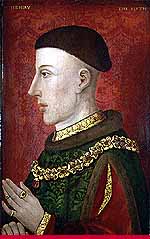
Henry V (artist unknown)
© Royal Collection |
 |
 |
|
|
Henry V
Soon after his accession, Henry V (reigned 1413-22) laid claim to all the Angevin lands in France. In 1415 he set sail for France, capturing Harfleur and defeating the French at the Battle of Agincourt. Subsequent campaigns gave Henry control of Normandy, and by the Treaty of Troyes (1420) he gained recognition as heir to the French throne. His success was, however, short-lived and he died of dysentery in 1422, leaving a nine-month-old son, Henry, to succeed him.
Henry VI
Henry VI (reigned 1422-61 and 1470-71) was crowned king of England in 1429 and, in 1431, king of France. The dual monarchy, and accompanying French war, proved too difficult for the king and England to maintain. The successes of the Dauphin and Joan of Arc began to weaken his grip on his French possessions and Normandy was lost in 1449. Henry's cultural patronage (he founded Eton and King's College, Cambridge) was outweighed by his lack of interest in administration, which alienated powerful nobles and encouraged factionalism.
In 1453 the king became ill and the Duke of York (a distant cousin descended from Edward III) was made Protector. The king recovered in 1455, but civil war between the Yorkist and Lancastrian factions broke out (the Wars of the Roses). The Duke of York was killed at the battle of Wakefield in 1460 and in 1461 his son, Edward, was crowned king, and Henry and his Queen fled to Scotland. Henry was captured and imprisoned in the Tower in 1465, but was restored to the throne in 1470. His brief period of freedom ended after the Battle of Tewkesbury in 1471 (in which his son Edward, Prince of Wales, was killed) when Edward IV regained the throne, and Henry was put to death in the Tower of London. |
|







