|
The HanoveriansGeorge IAs Sophia, Electress of Hanover, had died two months before Queen Anne (who died in 1714), Sophia's eldest son George, Elector of Hanover inherited the throne under the Act of Settlement (there were some 50 Roman Catholic relatives with stronger claims). His claim was challenged by James Stuart, Roman Catholic son of James II, who landed in Scotland in 1715, following a rising of Scottish clans on his behalf; this was unsuccessful and he soon withdrew. George I (reigned 1714-27) spoke German and French and a little English; he regularly visited Hanover to fulfil his duties there. Family tensions (George imprisoned his wife in 1694) and political intrigue (opposition gathered round the Prince of Wales) led to differences and intense dislike between George and his son, George. In 1719 and 1720, and during most of the king's absences in Hanover, power was delegated to a Regency Council and not to the Prince of Wales.Unfamiliar with the customs of the country, George was dependent on his ministers - the Whigs dominated Parliament during his reign. After the South Sea Bubble crisis of 1720 (when the South Sea Company, with heavy government and royal investments, crashed), Robert Walpole took over. The most able of George's ministers, and known as the first 'Prime Minister', Walpole's was the longest running administration in British history (1721-42). George died in 1727, during a visit to Hanover. George IIGeorge II (reigned 1727-60), at the age of 60, was the last British sovereign to fight alongside his soldiers, at the Battle of Dettingen in 1743 in Germany, against the French. Like his father, for much of his reign George's political options were limited by the strength of the Jacobite cause (James Stuart the Old Pretender, and then his son, Charles Edward Stuart), with which many of the Tories were linked. George's reign was threatened in 1745 when Charles Edward Stuart, the Young Pretender, landed in Scotland. After some initial success (which led to the popularity of the national anthem in its current form becoming popular among the Hanoverian loyalists), Charles was defeated at the Battle of Culloden in April 1746 and the Jacobite threat was over.The foundations of the industrial revolution were laid during George's reign, with new levels of production in industries such as coal and shipbuilding and also in agriculture, together with a rapid rise in population. Overseas, trade was boosted by successes such as Clive's victories in India at Arcot (1751) and Plassey (1757) which placed Madras and Bengal under British control, and Wolfe's capture of French-held Quebec in 1759 (part of a successful campaign which transferred Canada with its wealthy trade in fish and fur from Bourbon to British rule). As the country prospered and George's reign lengthened, George's early unpopularity (he did not travel far in England, and much preferred Hanover) changed into a general respect. The king's eldest son, Frederick, died in 1751. George's grandson therefore inherited the throne, on George's death in 1760. |
|||||||
|
George IIIGeorge III (1760-1820) was determined to appoint his own ministers and reassert some of the monarch's independence lost under the first two Georges. His reign saw the loss of the American colonies in 1783. After an uprising in Ireland in 1798, the Act of Union of 1801 linked Ireland and England and dissolved the Irish Parliament; instead Irish representatives went to the Westminster Parliament.George was a conscientious king and a devoted father and husband; his interest in botany and farming earned him the nickname 'Farmer George'. In 1788 he became mentally deranged, although this may have been due to porphyria, an hereditary physical disorder. George recovered by 1789, but then relapsed, becoming permanently deranged in 1810. George IVGeorge IV (1820-30) was 48 when he became Regent in 1811. He had secretly and illegally married a Roman Catholic, Mrs Fitzherbert. In 1795 he officially married Princess Caroline of Brunswick, but the marriage was a failure and he tried unsuccessfully to divorce her. Their only child, Princess Charlotte, died in childbirth in 1817. An outstanding, if extravagant, collector and builder, George IV acquired many important works of art (now in the Royal Collection), built the Royal Pavilion at Brighton, and transformed Windsor Castle and Buckingham Palace. He was succeeded by his brother, William IV (reigned 1830-37).William IVAt the age of 13 William became a midshipman and began a career in the Royal Navy. Between 1791 and 1811 he lived with his mistress, the actress, Mrs Jordan, and the growing family of their children known as the Fitzclarences. He became king in 1830. William's reign was dominated by the Reform crisis, during which the government pushed through parliamentary reform against Tory opposition, using the threat of creation of peers to do so. In 1832, William eventually signed the Great Reform Bill which abolished some of the worst abuses of the electoral system (for example, representation for so called 'rotten boroughs', where representatives were nominated rather than elected, was stopped) and extended the vote to the middle classes. He had married Princess Adelaide of Saxe-Meiningen in 1818, but their children died in infancy. |
||||||
|
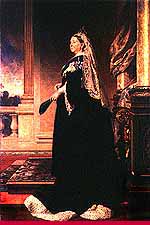
VictoriaWilliam was succeeded by his niece, Victoria (reigned 1837-1901), aged 18. As women could not inherit the Hanoverian throne, that throne passed to Victoria's uncle. During the early years of her reign, Victoria was heavily influenced by her Prime Minister, Lord Melbourne, and after 1840 by her husband, Prince Albert of Saxe-Coburg and Gotha. The marriage was very happy and they had nine children, many of whom married into European royal families. Albert supported the arts, trade and industry; his particular project was the Great Exhibition of 1851, the profits from which helped to establish the Victoria and Albert Museum, the Natural History Museum, Imperial College and the Albert Hall in London. In 1861 Albert died of typhoid. Victoria retreated into seclusion but still carried out her constitutional duties. In 1897 the queen celebrated her Diamond Jubilee amid scenes of popular enthusiasm. She had reigned longer than any other British monarch. |
||||||
    |
|||||||
 |
 |
 |
 |
|
|||