|
|
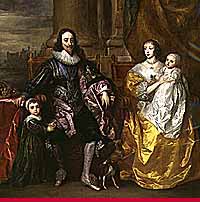
Charles ICharles I was born in Fife on 19 November 1600, the second son of James VI of Scotland (from 1603 also James I of England) and Anne of Denmark. He became heir to the throne on the death of his brother, Prince Henry, in 1612. He succeeded, as the second Stuart King of England, in 1625.Controversy and disputes dogged Charles throughout his reign. They eventually led to civil wars, first with the Scots from 1637 and later in England (1642-46 and 1648). Historians still disagree about the real causes of the conflict, but it is clear that Charles was not a successful ruler. Charles was reserved and he had a high concept of royal authority, believing in the divine right of kings. He was a good linguist and a sensitive man of refined tastes. He spent a lot on the arts, inviting the artists Van Dyck and Rubens to work in England, and buying a great collection of paintings by Raphael andTitian (this collection was later dispersed under Cromwell). His expenditure on his court and his picture collection greatly increased the crown's debts. Indeed, crippling lack of money was a key problem for both the early Stuart monarchs. Charles was also deeply religious. He favoured the high Anglican form of worship, with much ritual, while many of his subjects, particularly in Scotland, wanted plainer forms. Charles found himself ever more in disagreement on religious and financial matters with many leading citizens. He had married a Roman Catholic, Henrietta Maria of France, and this only made matters worse. He had inherited disagreements with Parliament from his father, but Charles's own actions (engaging in ill-fated war with France and Spain at the same time) eventually brought about a crisis in 1628-29. He dismissed his fourth Parliament in March 1629 and decided to make do without either its advice or the taxes which it alone could grant. Charles saw no reason to consult Parliament, believing that he was accountable only to God for his actions. His responsibilities to God included good government over his subjects. His opponents, however, later called this period 'the Eleven Years' Tyranny', though it was not especially 'tyrannical'. His leading advisers, including William Laud, Archbishop of Canterbury, and the Earl of Strafford, were efficient but unpopular, and for much of the 1630s the King gained most of the income he needed from duties on goods coming into the kingdom. He tried not to tax his subjects too highly, but some forms of taxation, like Ship Money - extended in 1635 from ports to the whole country - made him very unpopular, alienating many who were the natural supporters of the Crown. Charles was eventually forced to call another Parliament in 1640 in order to raise money for his war against the Scots, on whom he had recently tried to impose a High Church liturgy and prayer book. The Long Parliament started with the imprisonment of Laud and Strafford (later executed), the abolition of the King's Council (Star Chamber), and moved on to declare Ship Money and other fines illegal; the King agreed that Parliament could not be dissolved without its own consent. Charles rapidly lost control of the situation in England too, as uprisings in Ireland and Scotland raised tensions between the king and Parliament over the command of the army. Civil war broke out in 1642. Both Parliament and Charles decided to raise armies and the Battle of Edgehill showed that early on the fighting was even, but from 1644 onwards the armies raised by Parliament, under strong generals like Sir Thomas Fairfax and Oliver Cromwell, won decisive victories, especially at Marston Moor (1644) and Naseby (1645). The last years of Charles's reign saw him either in prison or trying to escape capture. His execution, however, was not inevitable. He had many opportunities to negotiate a reasonable compromise both with the English Parliament and the Scots in 1647-48, but he fatally weakened his position by trying to play one group off against another. Few felt that he could be trusted to keep his word. Eventually, on 20 January 1649, he was charged with high treason 'against the realm of England'. Charles refused to plead, saying that he did not recognise the legality of the High Court of Justice (established by Parliament earlier in the month). He was condemned to death on 27 January and beheaded outside the Banqueting Hall at Whitehall three days later. On 7 February 1649, the office of king was formally abolished; an Act was passed forbidding the proclaiming of another monarch. |
||||
    |
|||||
 |
 |
 |
 |
|
|