|
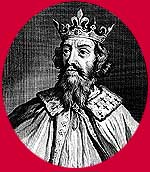
King Alfred (artist unknown)
© Royal Collection |
 |
 |
|
|
The Anglo-Saxon Kings
Following the withdrawal of the Roman soldiers at the beginning of the 5th century, there was a period of increasing disorder as a result of raids by Angles (from which the name 'England' is derived), Saxons and Jutes. The raiders began to settle and a number of small kingdoms were established. More powerful kingdoms emerged, claiming rights over whole areas. In the 8th century Offa, King of Mercia (reigned 757-96), established supremacy over many lesser kings and was the first ruler to be called 'King of the English', although it was not until the 10th century that England was united as a kingdom.
Alfred
From the late 8th century, there were attacks by Vikings from Scandinavia. The kingdoms of Northumbria and Mercia were rapidly over-run and in 871 the Danish army attacked Wessex. After initial setbacks, Alfred, King of Wessex (reigned 871-99) defeated the Danes at the Battle of Edington in 878. The Danes withdrew to an area north of a frontier running from London to Chester, which became known as the 'Danelaw'. Alfred then began a programme of reforms, including establishing a legal code, improving education and learning, and reforming the coinage. He also started a building programme of well-defended towns ('borough' comes from the Old English burgh, a fortress) and a new navy.
Athelstan
Alfred's successors reconquered the Danelaw. Athelstan (reigned 925-39) pushed the boundaries of the kingdom to their furthest extent and lesser kings in Scotland and Wales accepted him as overlord of the British.
Ethelred II, Sweyn, Canute
Ethelred II (reigned 978-1016) tried to buy off renewed attacks by the Vikings with money levied through a tax called the Danegeld. Eventually, in 1013 Ethelred fled to Normandy when Sweyn (the Danish king's son) dispossessed him; and Ethelred returned to rule after Sweyn's death in 1014. In 1016 the ruthless but capable Danish leader, Canute (reigned 1016-35), became king of England and later, as king of Denmark and Norway, overlord of a huge northern empire. This empire failed to survive Canute's sons.
Edward III
In 1042 Edward III, 'the Confessor' (reigned 1042-66), Ethelred's son, became king. Edward was responsible for building Westminster Abbey, and was reburied in a shrine there after his canonisation in 1161. Deeply religious, but with poor judgement, Edward failed to resolve the succession question (his marriage was childless).
Harold
On Edward's death in 1066, the king's council elected his brother-in-law, Harold Godwinson (Jan-Oct 1066), king. In September, Harald of Norway invaded England and was defeated by Harold at the Battle of Stamford Bridge near York. Meanwhile, William, Duke of Normandy (whom Harold had acknowledged in 1065 as Edward III's successor and who was also related to Edward by marriage) had landed in Sussex. Harold rushed south and on 14 October 1066 his army was defeated near Hastings and Harold was killed. |
|







