|
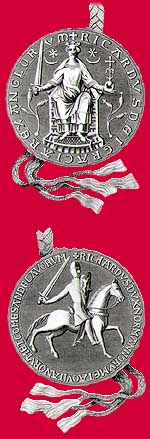
Seal of Richard I by James Basire (1730-1802)
© Royal Collection |
 |
 |
|
|
The Angevins
Henry II
Henry II (reigned 1154-89) ruled over an empire which stretched from the Scottish border to the Pyrenees. Married to Eleanor, the heiress of Aquitaine, the king spent only 13 years of his reign in England; the other 21 years were spent on the continent in his territories in what is now France.
By 1158, Henry had restored to the crown some of the lands and royal power lost by Stephen. For example, locally chosen sheriffs were changed into royally appointed agents charged with enforcing the law and collecting taxes in the counties. Personally interested in government and law, Henry strengthened royal justice, making use of juries and re-introduced the sending of justices (judges) on regular tours of the country to try cases for the Crown. His legal reforms have led him to be seen as the founder of English Common Law. Henry's disagreements with his Archbishop of Canterbury, Thomas Becket, over Church/State relations ended in Becket's murder in 1170. Family disputes almost wrecked the king's achievements and he died in 1189 at war with his sons.
Richard I
Henry's son, Richard I (reigned 1189-99), fulfilled his ambition by going on crusade in 1190 leaving the ruling of England to others. Returning from the Holy Land, Richard was captured in Austria and imprisoned in Germany for more than a year. In his absence, Philip Augustus, king of France, invaded Normandy. However by the time of his death, Richard had recovered all his lands. His success was short lived. In 1199 his brother, John, became king and Philip successfully invaded Normandy. By 1203 John had retreated to England, losing his French lands of Normandy and Anjou by 1205. |
|
|
 |
|
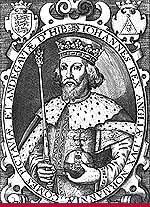
King John by Renold Elstrack (1571-1625)
© Royal Collection |
|
|
John and Magna Carta
John (reigned 1199-1216) was an able administrator interested in law and government but he neither trusted others, nor was trusted by them. Heavy taxation, disputes with the Church (John was excommunicated by the Pope in 1209) and unsuccessful attempts to recover his French possessions made him unpopular. Many of his barons rebelled and in June 1215 they forced the King to sign a peace treaty accepting their reforms.
This treaty, later known as Magna Carta, limited royal powers, defined feudal obligations between the king and the barons, and guaranteed a number of rights. The most influential clauses concerned the freedom of the Church; the redress of grievances of owners and tenants of land; the need to consult the Great Council of the Realm so as to prevent unjust taxation; mercantile and trading relationships; regulation of the machinery of justice so that justice be denied to no one; and the requirement to control the behaviour of royal officials. The most important clauses established the basis of habeas corpus ('you have the body'), i.e. that no one shall be imprisoned except by due process of law, and that 'to no one will we sell, to no one will we refuse or delay right or justice'.
The Charter also established a council of barons who were to ensure that the sovereign observed the Charter, with the right to wage war on him if he did not. Magna Carta was the first formal document insisting that the sovereign was as much under the rule of law as his people; and that the rights of individuals were to be upheld even against the wishes of the sovereign. As a source of fundamental constitutional principles, Magna Carta came to be seen as an important definition of aspects of English law, and in later centuries as the basis of the liberties of the English people.
As a peace treaty Magna Carta was a failure and the rebels invited Louis of France to become their king. When John died in 1216 England was in the grip of civil war. |
|







